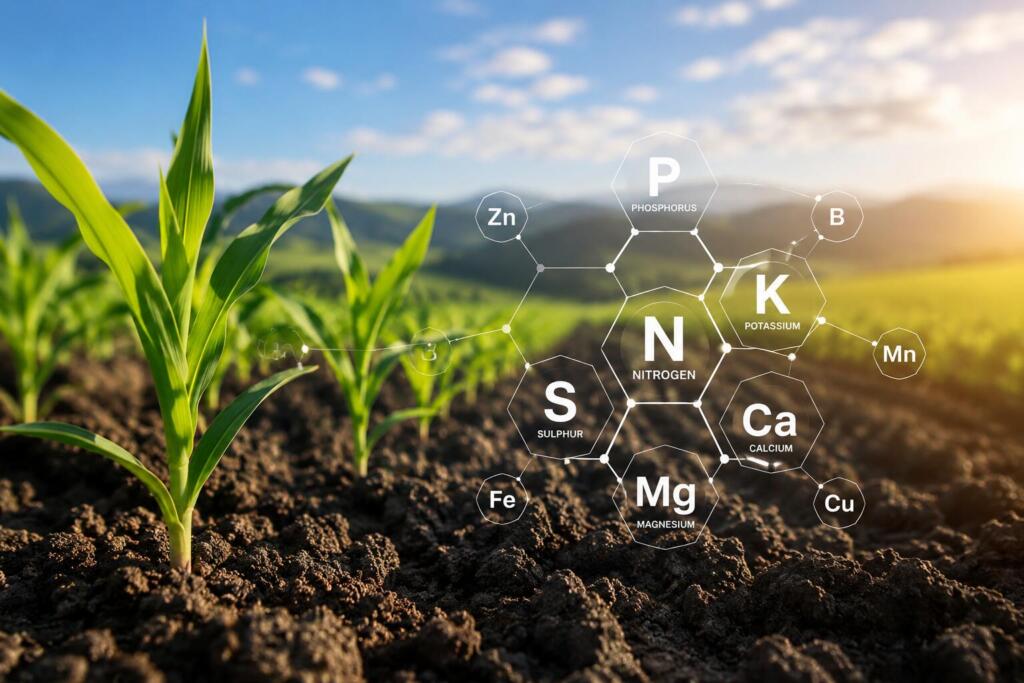
Modern crop nutrition is no longer simply about maximising fertiliser rates. Increasingly, the focus is on improving nutrient-use efficiency, biological availability and the balance between nutrients throughout the soil–plant system.
Yield, crop quality and resilience depend not only on how much fertiliser is applied, but also on whether nutrients are available at the right time and can be effectively absorbed and used by the crop.
Why visible symptoms can come too late
In-field crop assessments often focus on visible indicators such as canopy colour, biomass, pest pressure or flowering intensity.
However, nutrient constraints can begin to affect plant metabolism before clear visual symptoms develop. By the time a deficiency becomes obvious, crop performance or yield potential may already have been affected.
Nutrient uptake and utilisation are influenced by several interconnected factors, including:
- Soil chemistry and pH
- Moisture availability
- Microbial activity
- Root development
- Soil structure
- Weather conditions
- Plant growth stage
- Interactions between individual nutrients
This means that a high soil nutrient index or a high fertiliser application rate does not necessarily guarantee that the nutrient will be available to the crop.
The different roles of essential crop nutrients
Each nutrient performs a specific role within crop growth and development.
Nitrogen (N) supports vegetative growth, chlorophyll formation and protein synthesis. However, nitrogen is used most efficiently when the crop also has sufficient sulphur and other supporting nutrients.
Phosphorus (P) contributes to root development and energy transfer, particularly during crop establishment and periods of rapid growth.
Potassium (K) plays an important role in water regulation, enzyme activation and the crop’s response to drought, heat and other stresses.
Calcium (Ca) supports cell-wall development, root-tip growth and the structural strength of plant tissues.
Magnesium (Mg) forms part of the chlorophyll molecule and is therefore closely associated with photosynthesis and carbohydrate movement within the plant.
Sulphur (S) is needed for the formation of proteins and certain amino acids and can influence how efficiently the crop uses nitrogen.
Micronutrients, including zinc, boron, iron, manganese, copper and molybdenum, support enzyme activity, hormone regulation, reproductive development, grain filling and natural plant defence responses.
The challenge is therefore not simply to provide individual nutrients, but to ensure that the crop receives them in an appropriate and balanced form.
Liebig’s Law of the Minimum
The importance of nutrient balance is commonly illustrated by Liebig’s Barrel.
In this model, each stave of the barrel represents an individual nutrient. The amount of water that the barrel can retain is determined by its shortest stave.
In crop nutrition, this means that crop performance may be restricted by the nutrient that is in shortest supply or is least available to the plant, regardless of how much of the other nutrients are present.
Liebig’s Barrel – The shortest stave limits crop performance
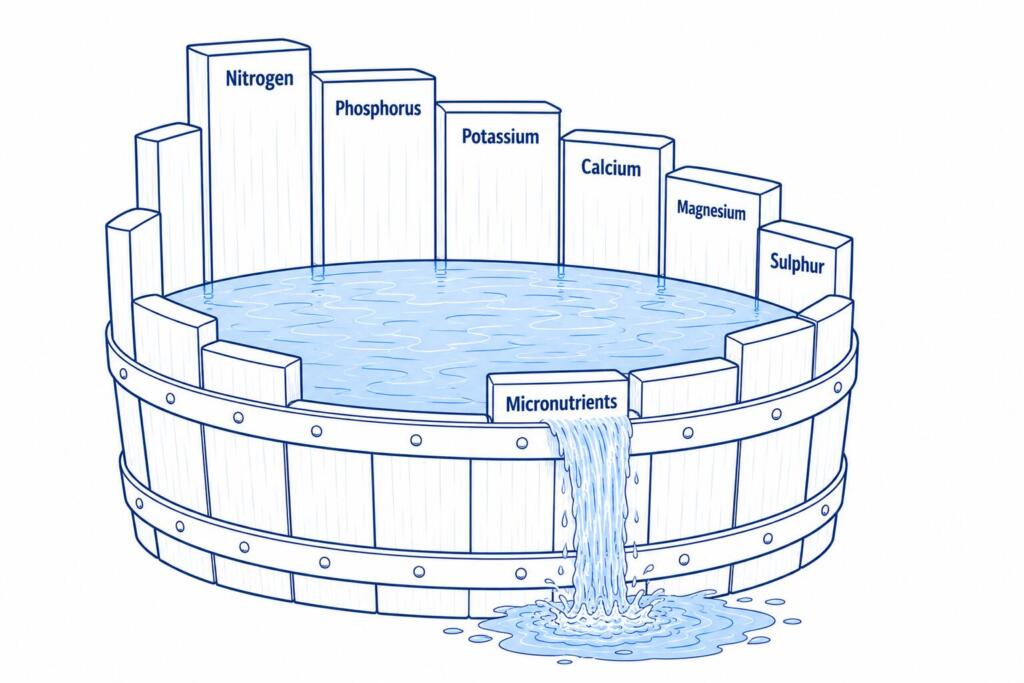
Liebig’s Barrel illustrates how crop performance can be limited by the nutrient in shortest supply. In this example, micronutrient availability determines the maximum level of performance.
High nitrogen applications, for example, cannot fully compensate for an inadequate supply of sulphur or essential micronutrients.
Similarly, high soil phosphorus levels do not necessarily ensure adequate crop uptake where root growth, soil conditions or interactions with other nutrients restrict availability.
The result can be:
- Reduced nutrient-use efficiency
- Unnecessary fertiliser expenditure
- Lower crop performance
- Hidden yield loss
- Greater risk of unused nutrients remaining within the system
The practical objective is therefore to identify and address the shortest stave rather than continuing to add more of nutrients that are already sufficiently available.
How nutrients interact
Liebig’s Law helps explain which nutrient may be limiting crop performance, but it does not fully explain why nutrient imbalances can remain within apparently well-fertilised systems.
This is illustrated by Mulder’s Chart of Synergism and Antagonism, which shows how nutrients can influence the uptake and utilisation of one another.
A synergistic relationship occurs where one nutrient supports the uptake or function of another.
An antagonistic relationship occurs where a high level of one nutrient can restrict the availability, uptake or utilisation of another.
Examples can include:
- High potassium availability affecting magnesium or calcium uptake
- High phosphorus levels influencing the availability of certain micronutrients under some soil conditions
- Nitrogen-use efficiency being affected by insufficient sulphur
- Nutrient uptake being restricted by poor root function or unsuitable soil pH
These interactions help explain why crop constraints can still occur even where soil analysis shows adequate or high overall nutrient levels.
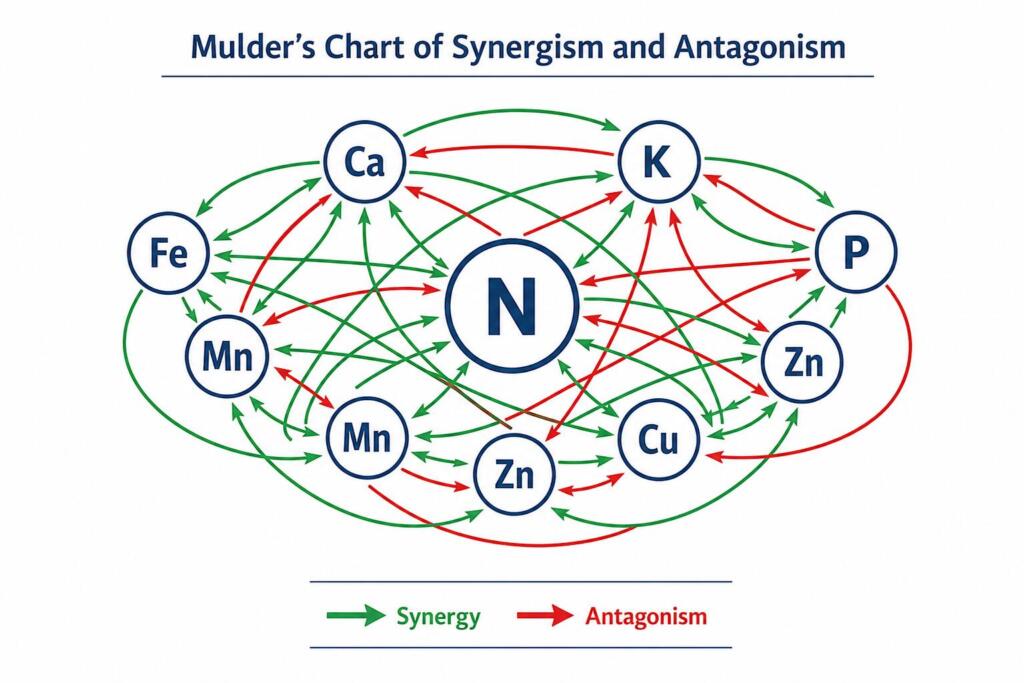
Mulder’s Chart illustrates how nutrients can support or restrict the uptake and utilisation of other nutrients within the soil–plant system.
Soil analysis remains an important starting point, but results should be considered alongside crop condition, field history, soil structure, rooting, weather and the intended yield or quality objective.
Managing nutrient balance as a complete system
Root development is not dependent on phosphorus alone. It is influenced by interactions involving phosphorus, calcium, magnesium, micronutrients, soil structure and moisture availability.
Crop health is not determined by crop protection chemistry alone; balanced nutrition also supports cell integrity, metabolic function and natural plant defence responses.
High yield is therefore not simply a nitrogen story. It is the result of coordinated nutrient uptake, movement and utilisation throughout the growing season.
Effective crop nutrition requires an integrated approach that considers:
- The crop’s nutritional demand
- Soil nutrient availability
- Root development
- Soil biology and structure
- Weather and moisture conditions
- The timing and form of nutrient applications
- Interactions between nutrients
By identifying the nutrient or condition that is genuinely limiting performance, growers and agronomists can make more targeted decisions and improve the return achieved from fertiliser inputs.
Matching nitrogen availability to crop demand
Balanced crop nutrition also involves matching the form and timing of nitrogen applications to crop demand.
Slow-release nitrogen products can form part of a wider crop nutrition strategy by providing an additional source of nitrogen over an extended period. However, they should be used alongside appropriate management of sulphur, magnesium, micronutrients and other crop requirements.
NUE28™ is a slow-release nitrogen fertiliser manufactured by TS Resins. It combines immediately available urea nitrogen with methylene urea nitrogen designed to release more gradually.
Its use should be considered as part of a complete crop nutrition programme rather than as a substitute for balanced nutrient management.
Farmers should speak to their agronomist or fertiliser distributor when assessing nutrient requirements and deciding how products such as NUE28™ may fit within an individual crop programme.
What is the shortest stave in your crop nutrition programme?
The most important question may not be which nutrient is being applied at the highest rate, but which nutrient or soil condition is currently limiting the crop’s ability to use the inputs already available.
Which “short stave” is most frequently encountered in your crop nutrition programmes, and how often is it hidden by the overall level of fertiliser application?