
Rising geopolitical tensions, unpredictable weather, and increasing input costs are making fertiliser planning more difficult than at any point in recent years. As prices remain volatile, farmers are being encouraged to focus on efficiency, flexibility, and timely decision making to protect crop performance.
Pressure on Global Supply
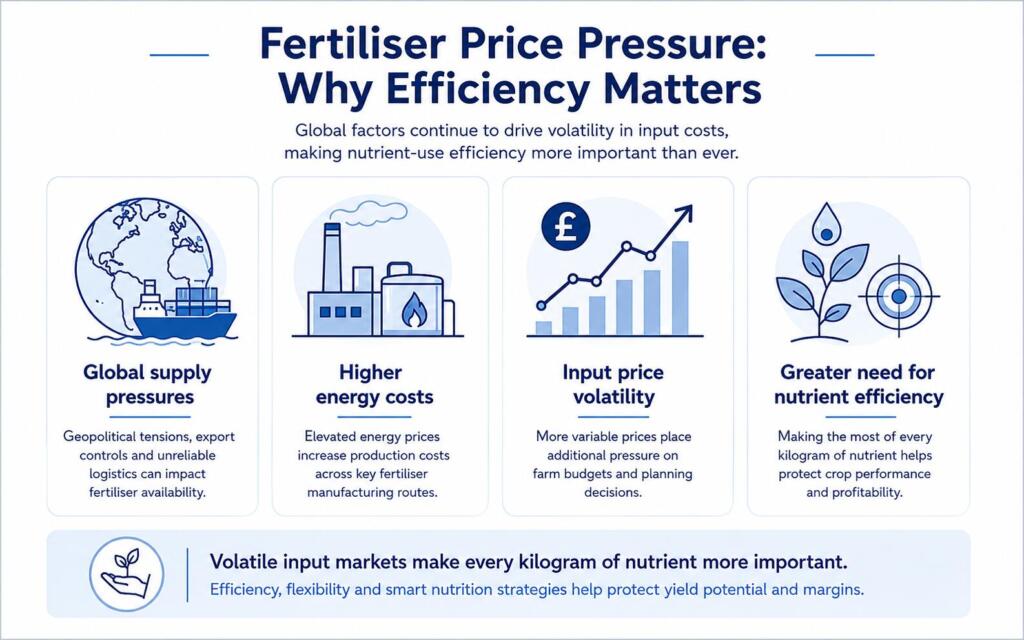
Geopolitical tensions in several parts of the world continue to place pressure on global fertiliser supply chains. Export controls, unreliable transport routes, and rising production costs can all affect fertiliser availability and pricing for growers.
The effects are particularly relevant in the import reliant UK. Farmers planning for the coming season are facing an uncertain market, making forward decisions harder than usual.
What This Means for Farms and Food Production
One of the most immediate consequences of this uncertainty is pressure on fertiliser prices. Reduced availability in some markets, elevated energy costs, and ongoing logistical challenges have contributed to higher and more variable input costs, placing additional pressure on farm budgets at a time when margins are already tight.
Some farmers may also face delivery delays or difficulty securing the products they would normally use. That combination of uncertainty and cost makes every application decision more difficult, and it increases the importance of making every kilogram of nutrient work as hard as possible.
This has wider implications for food production. Nutrients are essential for crop health and yield, so any disruption to supply, cost, or timing can affect both the quantity and quality of produce. If inputs are reduced or applied at the wrong time because of supply or price constraints, crop performance may suffer, with potential knock-on effects on food availability and consumer prices.
Practical On-Farm Responses
Industry bodies and agricultural organisations continue to highlight the need for stable fertiliser markets and resilient supply chains. In the meantime, many farmers are focusing on practical steps they can take on farm, including closer communication with suppliers, forward purchasing where appropriate, and more flexible nutrient planning.
Why Foliar Fertilisers Are Gaining Attention
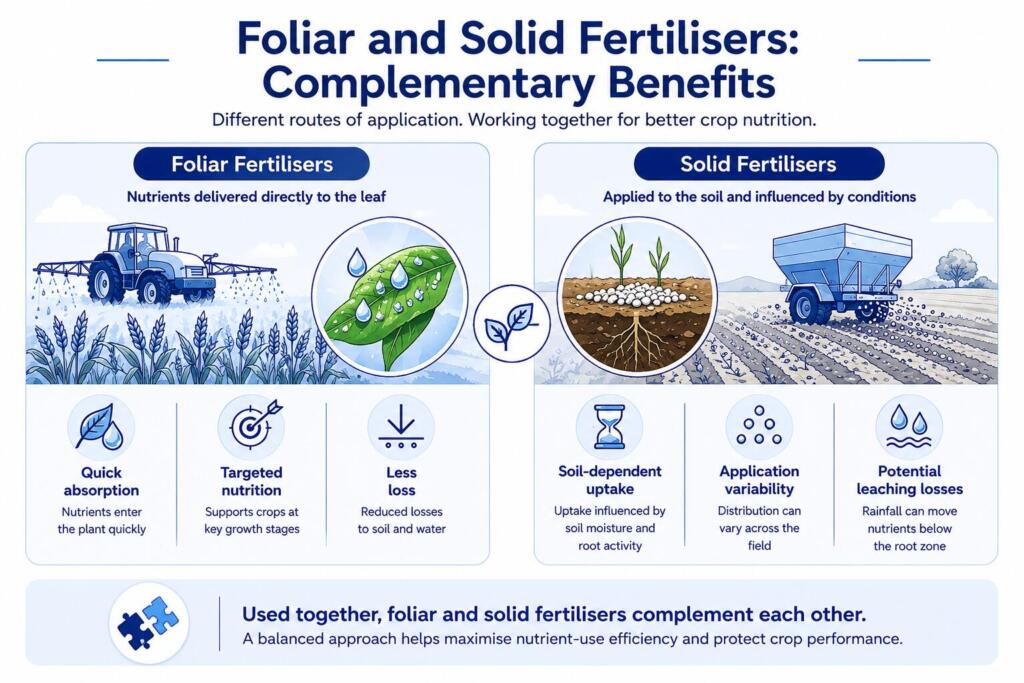
Against this backdrop, foliar fertilisers are receiving more attention as a useful option during periods of supply uncertainty or challenging growing conditions. Applied directly to crop leaves, they allow nutrients to enter the plant quickly and can be especially effective at correcting deficiencies during key growth stages.
Because nutrients are delivered directly to the plant, losses to the soil can be reduced. In some situations, smaller, more targeted applications can therefore produce visible results. Foliar fertilisers are not intended to replace traditional soil applied programmes, but they can help stretch existing resources and improve nutrient-use efficiency when availability, cost, or weather conditions create additional pressure.
Weather Can Limit Fertiliser Performance
Weather conditions also have a major influence on how well solid fertilisers perform in the field. After a wet winter, a dry spring can leave nitrogen granules sitting on the soil surface while crops begin to lose momentum at key growth stages such as tillering. On the other hand, heavy rainfall after application can wash nutrients below the root zone, reducing uptake and wasting part of a significant fertiliser investment.
Cereals and oilseed rape are particularly exposed to these challenges, especially in early spring when cold soils can limit root activity even if fertiliser has been applied on time. In these conditions, foliar nutrition can provide a practical means of support. It can supply a timely boost of nitrogen or micronutrients to cereals, while in oilseed rape it can help maintain canopy development and support recovery from weather-related stress.
Used alongside traditional programmes, foliar feeding can help farmers respond more effectively to changing conditions and get better value from every kilogram of nutrient applied.

Biostimulants as Part of a Flexible Strategy
Biostimulants offer another supportive approach, particularly as challenging growing conditions become more frequent. Although they have sometimes been viewed sceptically, biostimulants are an increasingly researched and rapidly developing area within crop input technology.
They are often discussed in terms of their technological and scientific development:
- 1st generation: traditional, naturally derived biostimulants used empirically in agriculture.
- 2nd generation: products with optimised composition and improved extraction processes.
- 3rd generation: biotechnology-based products formulated to activate specific metabolic pathways.
- 4th generation: products developed using advanced biotechnology and biological engineering.
Rather than supplying nutrients directly, biostimulants help plants make better use of the nutrients already available. They can encourage stronger root development, support beneficial soil interactions, and improve the plant’s natural processes for nutrient uptake and transport.
These effects can be particularly valuable when crops are under stress, whether from limited nutrient availability, poor soil conditions, or adverse weather. By improving nutrient absorption and utilisation, biostimulants can contribute to healthier growth and more consistent yields, even when fertiliser inputs are reduced or applied at lower rates.
When used alongside soil applied and foliar fertilisers, biostimulants can form part of a more resilient and flexible nutrient management strategy. Together, these tools can help reduce waste, improve return on fertiliser investment, and support crop stability during periods of market volatility.
Making Every Nutrient Count
In a period marked by geopolitical uncertainty, rising input costs, and increasingly unpredictable weather, farmers are being asked to do more with less while still protecting crop performance and profitability. That makes nutrient efficiency and flexibility more important than ever.
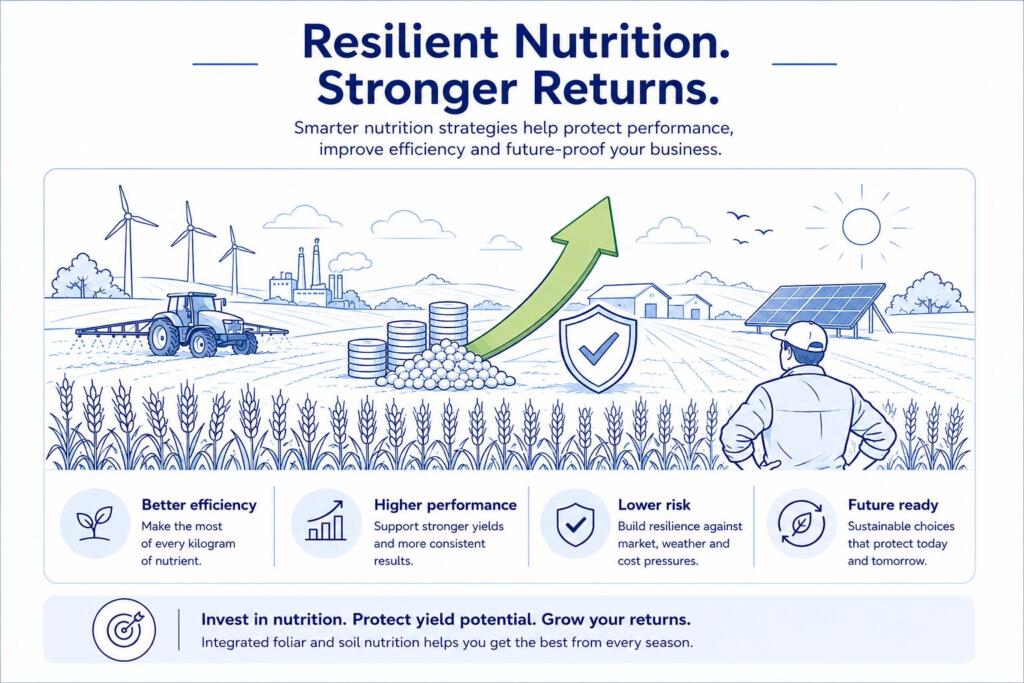
By making better use of tools such as foliar fertilisers and biostimulants, growers can respond more effectively to changing conditions, support crop growth when soil-applied fertilisers underperform, and ensure that every kilogram of nutrient delivers maximum agronomic and financial value.
Now is the time to review nutrient strategies, identify where efficiency can be improved, and consider how foliar fertilisers and biostimulants could help protect crop performance in an increasingly unpredictable season.
By taking a more flexible and targeted approach to crop nutrition, farmers can reduce risk, make better use of inputs, and stay one step ahead of rising costs and changing conditions. As the season develops, working closely with advisers and suppliers can help build nutrient programmes that respond to real-time crop needs rather than relying on traditional approaches alone.
To find out more about how TS Resins supports distributors with foliar nutrition and nutrient-use efficiency solutions, contact the TS Resins team.